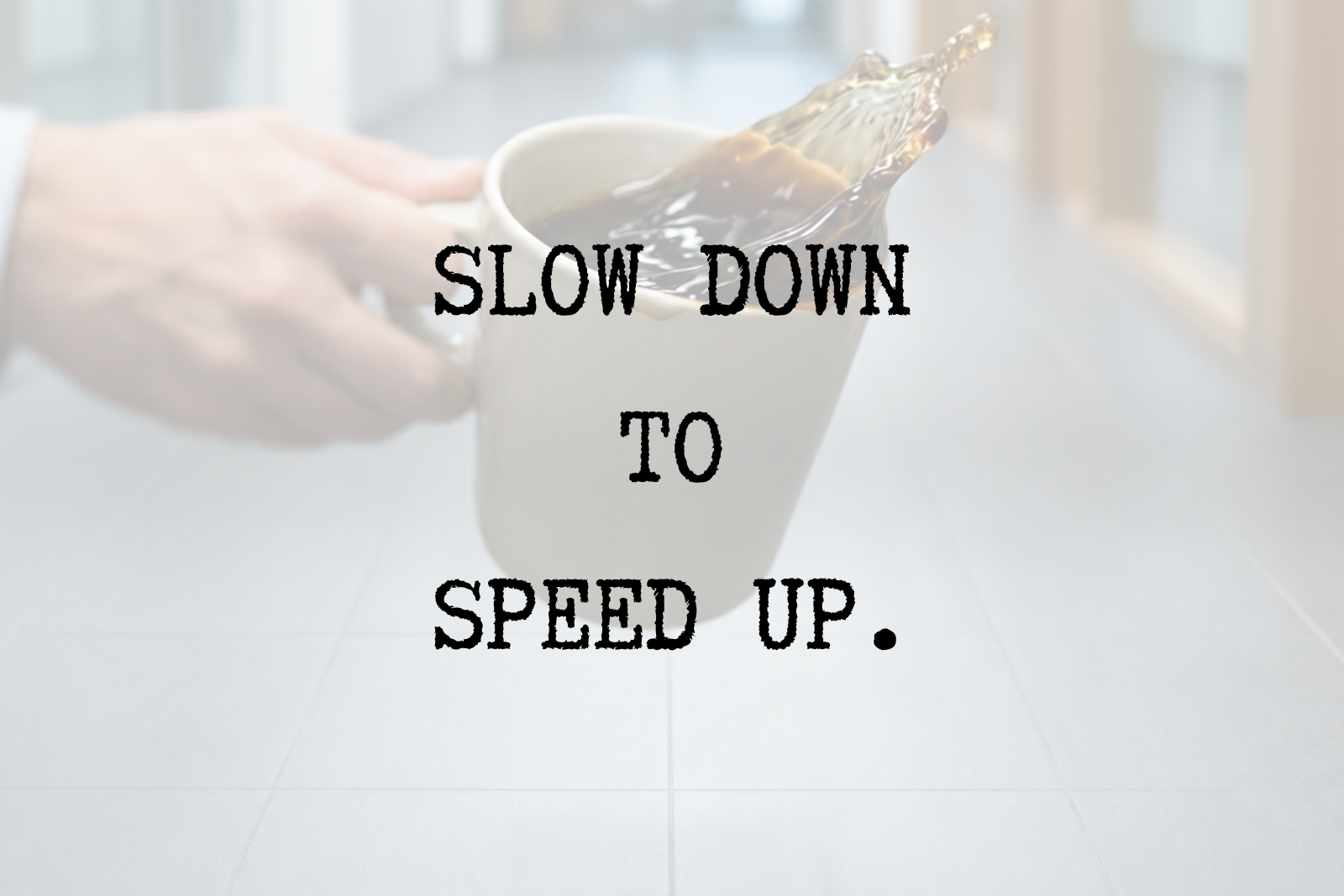
Slow down to speed up
Slow down to speed up
The secret to leadership might just be: don’t wear your coffee.
I'm standing in the hallway outside my office holding an empty mug.
Well, not completely empty.
There's about a quarter inch of coffee left at the bottom, which feels less like a consolation prize and more like evidence at a crime scene.
The rest of it is decorating the tile floor in a pattern that looks like someone tried to map the Pacific Northwest using only caffeine. There's a splatter on my left shoe. Another on my right pant leg. And a particularly impressive streak that somehow defied physics to land on the wall behind me.
I was walking too fast.
(I know this because I'm always walking too fast.)
Here's the thing about speed: it's a loan with terrible interest rates.
Turns out, I'm not alone in my coffee-spilling chaos. Research shows that when employees are stressed, they make 52% more mistakes at work. And those mistakes? They cost U.S. employers over $300 billion annually in lost productivity, turnover and damage control.
That's a lot of spilled coffee.
You borrow time now by rushing, and you pay it back later, with penalties. The email you fire off without proofreading comes back requiring a correction. The meeting you rush into unprepared costs you a follow-up meeting. The coffee you spill while sprinting down the hallway buys you two minutes of cleanup time you didn't have.
It's the opposite of compound interest.
It's compound chaos.
The physics of coffee spills are actually fascinating.
When you walk, your gait creates a rhythm. Coffee has a natural frequency, the rate it wants to slosh back and forth in whatever container is holding it. If your walking speed matches that frequency, you create resonance. The liquid amplifies its own motion until it breaches the rim.
It's the same principle that can cause bridges to collapse or buildings to sway.
Except instead of catastrophic structural failure, you just get a wet sock and the lingering shame of being a grown adult who can't successfully transport beverages.
Here's what I was thinking about when I spilled the coffee:
The email I needed to send.
The call I was about to be late for.
The meeting after that.
The script due tomorrow.
The text message I hadn't answered.
Whether I'd remembered to respond to that LinkedIn message.
If there was anything in the fridge that could pass as dinner.
Here's what I wasn't thinking about:
The coffee.
The mug.
My speed.
The fact that liquid physics don't care about my calendar.
I've done this before.
(Multiple times, if we're being honest.)
You'd think I'd learn. You'd think after the second or third incident, I'd implement some kind of corrective action plan. Maybe slow down. Maybe fill the mug less. Maybe invest in one of those travel mugs with the sippy lid that makes you look like an overgrown toddler but at least keeps your coffee in place.
Instead, I just keep walking fast and hoping for different results.
Which, as we all know, is the definition of insanity.
The real problem isn't the coffee.
The real problem is that I've convinced myself that moving faster equals productivity. That if I can just squeeze one more thing into this hour, answer one more email while transitioning between meetings, grab coffee and review notes simultaneously, I'll somehow bend time in my favor.
But here's what actually happens:
I spill coffee and lose two minutes cleaning it up.
I send an email with a typo because I was rushing and have to send a correction. Or worse, hit “reply all” when I was a BCC and have to sprint to find the “undo send” option.
I'm physically present in a meeting but mentally still in the last one, so I miss something important and have to circle back later.
I walk fast but arrive frazzled instead of ready.
I speed up now and pay for it later.
Every single time.
Slow down to speed up.
It sounds like a contradiction, but it's not.
It's an investment.
The time you spend now, walking at a normal pace, reading the email before you send it, actually listening in the meeting instead of multitasking, pays dividends later. You don't have to clean up the mess. You don't have to double back. You don't have to re-do the thing you rushed through the first time.
You actually get where you're going faster.
With coffee in your mug instead of on your pants.
I'm not suggesting we all move like we're underwater.
I'm not advocating for the elimination of urgency or the abandonment of deadlines.
I'm just noticing that the math doesn't work the way we think it does.
Rushing creates friction. Friction creates heat. Heat creates mistakes. Mistakes create more work.
And suddenly you're not ahead, you’re behind, just with more chaos to show for it.
I picked up the mug.
Grabbed paper towels.
Cleaned up the mess.
The wall required more effort than I'd like to admit.
Then I walked back to the kitchen to refill my coffee.
Halfway full instead of to the brim.
Turns out, accepting limitations is part of the solution.
When I got back to my office, the meeting I was rushing to had already started. I joined three minutes late, but at least I had coffee to drink during the call.
And dry pants.
(Mostly dry pants.)
I didn't waste the first ten minutes of the meeting distracted by the coffee stain on my leg and the nagging awareness that I'm a functioning adult who apparently can't master basic beverage transport.
I was actually present.
Which, it turns out, made the meeting go faster.
There's probably a leadership lesson in here about sustainable pace and strategic thinking and the long-term benefits of deliberate action.
But mostly I'm just tired of wasting perfectly-good coffee.
And tired of believing that rushing is the same as efficiency.
It's not.
Slow down now.
Speed up later.
And keep your coffee in the mug where it belongs.