Call Sign: Colonel Champagne Chablis Carrington
Call Sign: Colonel Champagne Chablis Carrington
When 4 syllable names aren’t enough

We send the event planner two names before we've even seen the venue.
Colonel Champagne Chablis Carrington. Alexis Appoggiatura Rallentando.
Four syllables were apparently not enough for either of us.
Not stage names. Nametag names. The kind that get printed, laminated and clipped to a lanyard right next to the WiFi password - mailed to a stranger who has never met either of us, weeks before we set foot in the building.
Appoggiatura and rallentando are both real music terms, for the record - an ornamental note and the instruction to slow down. Seemed fitting for a singing event…that went full soap opera - amnesia, long-lost siblings, a wedding interrupted by someone presumed dead, amnesia, over-dramatic slaps, the works. You'd be amazed how often "please print an alias with a tragic backstory on our tags" turns out to be a professional service we quietly provide, right up there with "please don't let the CEO near the karaoke mic.")
For the record, this isn't a one-time bit. It's closer to a chronic condition.
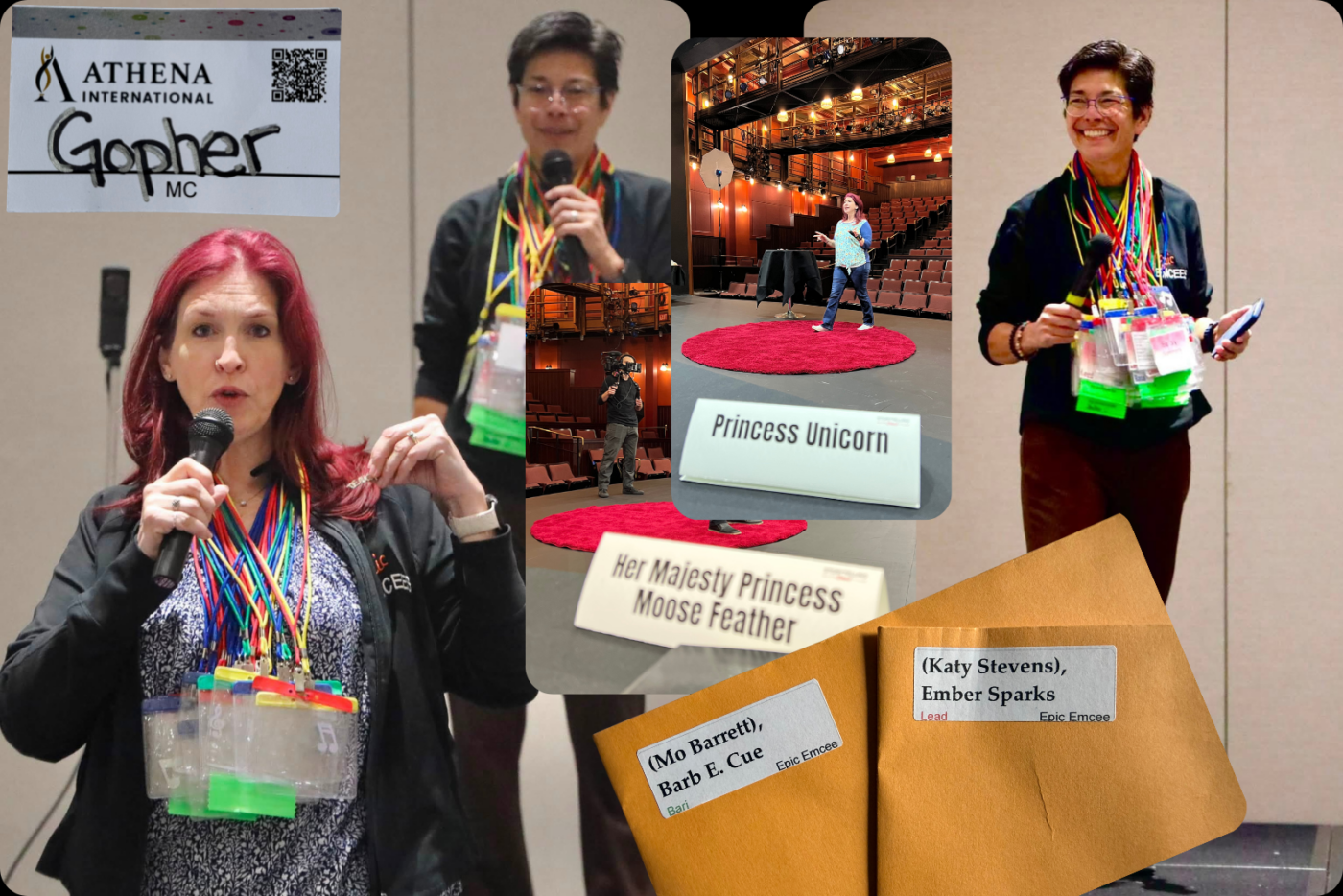
Past lanyards have read Barb E. Cue and Ember Sparks (a fire-themed event - exactly what it sounds like).
Gopher and Julie (leadership conference, aboard a cruise ship - we know, we know, we loved it too).
Princess Unicorn and Her Majesty Princess Moose Feather (a speakers' training weekend; the flyer said "workshop," the vibe said otherwise).
Every planner we've sent one of these to has had the same two options: laugh or reply with the professional equivalent of a slow blink - "let's just go with your real names."
Both are fine. That's kind of the point.
Here's a correction to my previous thought on this: I had the mechanism backwards.
Formerly, I thought this was akin to military call signs - the whole "squadron watches you screw up for a year, then decides who you are" tradition.
Real thing. One aviator's call sign is literally MEATLOAF, an acronym for "My EPU Activated due to A Total Lack of Any Fuel," which is aviation-speak for "ran out of gas and had a very bad day," and proof that the Air Force will workshop an acronym before it'll comfort a friend.
Another guy got "Pappy" for being older than everyone else in the squadron, which is the gentlest way a group of adults has ever told someone "you're old now."
Once a call sign sticks, it's permanent. No rebrand. No "actually, let's go with something else." No appeal process. No lawyer.
The word doing all the work in that last paragraph is sticks. Plenty of call signs go through a rough draft first. One squadron's only female pilot started out as "Barbie" because she didn't look like anyone's idea of a fighter pilot and people kept making the mistake of saying so out loud, usually right before she drank them under the table and covered their cab home out of pity. "Barbie" didn't survive a rough night with actual Malibu rum. She got violently, unforgettably sick, swore it off for life and walked into the next flight brief as "Malibu." That's the one that stuck permanently, no appeals, same as always. Same person, much better name and the squadron only needed one bad bottle of rum to get there.
Rank doesn't buy you an exemption either. Jim Mattis - four-star general, future Secretary of Defense, a man other Marines talk about like he personally invented discipline - once noticed the word CHAOS scrawled on his operations officer's whiteboard and asked what it stood for. The answer came back completely straight-faced: "Colonel Has An Outstanding Solution."
Translation: sir, your ideas are fine, let's not pretend they're all outstanding, and maybe have fewer of them before lunch. Mattis kept it as his call sign for the rest of his career and eventually put it on the cover of his own memoir, meaning a future Secretary of Defense let his staff's backhanded joke follow him to the bookstore. If he doesn't get a waiver, nobody does.
The rule that makes the whole system work: you cannot name yourself.
Want it too much and you end up worse off than if you'd said nothing. A guy in one unit spent a year openly hoping for something better than his own actual first name (John) which he'd decided was boring, a real letdown of a name, barely a placeholder.
His squadron heard every bit of that hoping. They let him wonder. They took their time. His call sign is… John. Not Big John. Not Johnny. John. Even the paperwork felt a little sorry for him.
Which means Colonel Champagne Chablis Carrington and Alexis Appoggiatura Rallentando should be in even more trouble than John. We didn't just fail to earn them. We didn't even wait around long enough to be denied one. We picked our own, on purpose, in broad daylight, and mailed them to a total stranger like that's a normal thing adults do.
Yet, every event planner has chosen the laugh and print option.
And once I actually looked at why, the research pointed somewhere I didn't expect - not at the guests wearing lanyards. At the email.
Erving Goffman, the sociologist who basically invented the idea that social life is a performance (a man who, as far as I can tell, never once had to explain "Alexis Appoggiatura Rallentando" to a hotel banquet manager), split every interaction into two spaces: front stage, where you manage the polished, official version of yourself and backstage, where the props get built, the seams show and somebody's always hunting for a stapler. His real point wasn't about theater. It was about trust. Letting someone see the unfinished, slightly absurd version of a thing before the audience does is one of the fastest ways to turn a stranger into a collaborator instead of a spectator.
An event planner's inbox is entirely front stage. AV specs. Load-in times. "Please confirm headcount by Friday," typed in a font that somehow still manages to sound stressed. Then one email shows up asking her to print "Alexis Appoggiatura Rallentando" on a nametag, and without meaning to, we've handed her a peek backstage before we've even shaken her hand.
There's a study that fits even better here. In 2013, researchers at Illinois State (Sprecher, Treger, and Wondra) had strangers meet for the first time and take turns disclosing something personal. The person listening liked their partner more than the person disclosing did, right up until the roles reversed and then everyone caught up. Good news for anyone who has ever monopolized a first date with their own life story: turns out you were doing it backwards. The finding worth stealing: it's not the content of what you share that builds liking. It's the act of handing something over that isn't buttoned up.
A goofy nametag name is about as low-stakes a disclosure as exists - nobody's crying over "Colonel Champagne Chablis Carrington" at two in the morning - but it's still a disclosure. It says: here's a small, slightly ridiculous piece of who we are, before you've met us, no strings attached, no NDA required.
Timing matters more than you'd guess, too. A 2019 customer-service study (Chiew, Mathies, and Patterson) found humor from a service provider lands measurably, not just anecdotally, when the other person is already stressed going into the interaction. Event planners are, definitionally, stressed. Three weeks out from a deadline they didn't set, managing a budget they didn't approve, for an executive who changed the theme twice and just texted "quick thought!" at 11 p.m. An email that makes someone laugh instead of adding a line item is doing real work at exactly the moment they need it done - cheaper than therapy, faster than wine.
By the time we walk into that venue, the planner isn't managing two vendors named Mo and Katy. She's in on a bit with Colonel Champagne Chablis Carrington and Alexis Appoggiatura Rallentando.
That's the relationship.
Everything after: the run of show, the last-minute mic swap, the "can you stall for four minutes," gets easier, because we didn't start as a line item. We started as a joke she was invited into.
Said out loud, all of that sounds a little like a manipulation seminar with better lighting and a much worse continental breakfast. I've thought about that, so let me save you the trouble: manipulation needs a secret. It only works if the other person doesn't know what you're actually doing and if the whole thing benefits you at their expense.
Neither is true here.
The planner knows exactly what "Alexis Appoggiatura Rallentando" is: a goofy name on a nametag, nothing hidden about it, no seminar required, and she's free to say no, print our real names and never think about either of us again. Nobody's taken us up on that yet. Not because we tricked them into liking it. Because a stupid, well-meant joke in the middle of a stressful week is just genuinely nice and people can tell the difference between nice and calculated even when they can't explain how.
The guests get their own version of this later and it's real. Put someone in a persona for a night and they'll take risks the real them wouldn't - ask anyone who's done karaoke under a fake name and suddenly found a high note the real them never had. That's psychology too, just a different study, for a different post. But it's not the first bridge. The planner is.
So no, we didn't earn "Colonel Champagne Chablis Carrington" the way a pilot earns a call sign. Nobody watched us for a year first. Nobody watched us at all. We just showed up in someone's inbox, uninvited, claiming a rank nobody gave us and a backstory neither of us has.
We just handed someone the backstage pass before the house lights came up and trusted her to walk through it with us.
She always does. And so far, nobody's asked for “John."