The High-Five Stranger
The High-Five Stranger
The power of a 2-second interaction

The US Women’s National Team is up a goal, deep into the second half of the final match of the FIFA World Cup, and I am not okay.
I'm in a sports bar in a city I don't live in. My eyes are glued to the largest TV airing the match. My hands are wrapped around a beer I stopped drinking ten minutes ago. There's a corner kick coming. You can feel a corner kick coming the way you feel a storm rolling in - nothing’s happened yet and you're already scanning the horizon for Dorothy, the Tin Man and the Scarecrow.
The ball goes up. Bodies go up with it. For one full second, the entire bar exists in the space between a cross and a header, and nobody is breathing, including several people who did not know, when they walked in, that this was going to be their Sunday.
Header connects.
Back of the net.
I am up out of my seat before I've decided to stand. My arm's already airborne, aimed at the nearest available human, who happens to be a guy at the next table who I will later learn came in for wings and Wi-Fi and had, up to this exact second, been quietly checking his email.
He high-fives me anyway.
Not because he cares about women’s soccer. He doesn't, not really. I find that out ninety seconds later when he asks, with real and unguarded confusion, “Who scored?"
He high-fived me because a stranger's arm shot into the air next to him with that much conviction, and the body does the math faster than the brain gets a vote.
Something happened.
Somebody's thrilled.
Hand goes up.
Sort out the details later, if at all.
I don't know his name. I don't know if he's a decent person. For all I know, he double-parks, or reply-alls or never tips more than 11%.
None of that mattered for the two seconds our hands were in the air.
In that window, whatever he actually felt or knew about women's soccer, he was exactly, completely, my teammate.
I've been him, too.
Different bar, different sport on another Sunday, back nine of some golf thing I'd fail a pop quiz on. Sound off. Captions on. Mostly there for the fries.
Somebody two stools down comes half out of his chair over a golf thing a golf guy did with his golf stick. His arm's up before I've located the ball on screen.
Mine goes up to meet it anyway.
No information. No stake in the outcome. Pure reflex. The same reflex that makes you flinch at someone else's jump scare in a movie you're not even watching.
I have no idea what team was golfing, what inning/quarter/period it was or why it mattered enough to get a grown man off a bar stool.
Doesn't matter.
A stranger's arm shot into the air next to me with that much conviction and my body did the math faster than my brain got a vote.
(I would like the record to show I have never once known what's happening during golf.)
Watch the replay in your head, either version.
The play happens. There's a flicker - did that just happen? Was that real? And then you look, involuntarily, at the nearest human to confirm it.
Not to explain it.
Not to analyze it.
Just to check:
Did you feel that too?
The high five isn't the reaction.
It's the receipt.
Sometimes you're the one writing it. Sometimes you're the one signing for the delivery.
Either way, you walk away with proof that, for one tiny moment, somebody else was right there with you.
I think that's part of what I love about being in a room with other people.
A joke can do the same thing a corner kick does. So can a song. So can an unexpected moment when somebody says the thing everyone else was thinking but nobody had said out loud.
Something happens.
You laugh.
And then, almost before you've finished laughing, you hear somebody else laughing.
You turn.
They're already looking at you.
There it is:
Oh, you too.
That's a different experience than laughing alone in your kitchen.
The joke might be exactly as funny. The song might be exactly as good. But now there's another human being in the moment with you, and suddenly the moment has somewhere to go.
It travels.
Across a row.
Across a table.
Across a room.
Sometimes it even finds the person who came in for wings and Wi-Fi.
Katy and I chase that moment when we're onstage.
Not just the laugh. The little beat after it, when people realize they're laughing together.
The moment someone catches the eye of a stranger three seats away.
The moment a room that arrived as a collection of individuals discovers, almost accidentally, that it's a room.
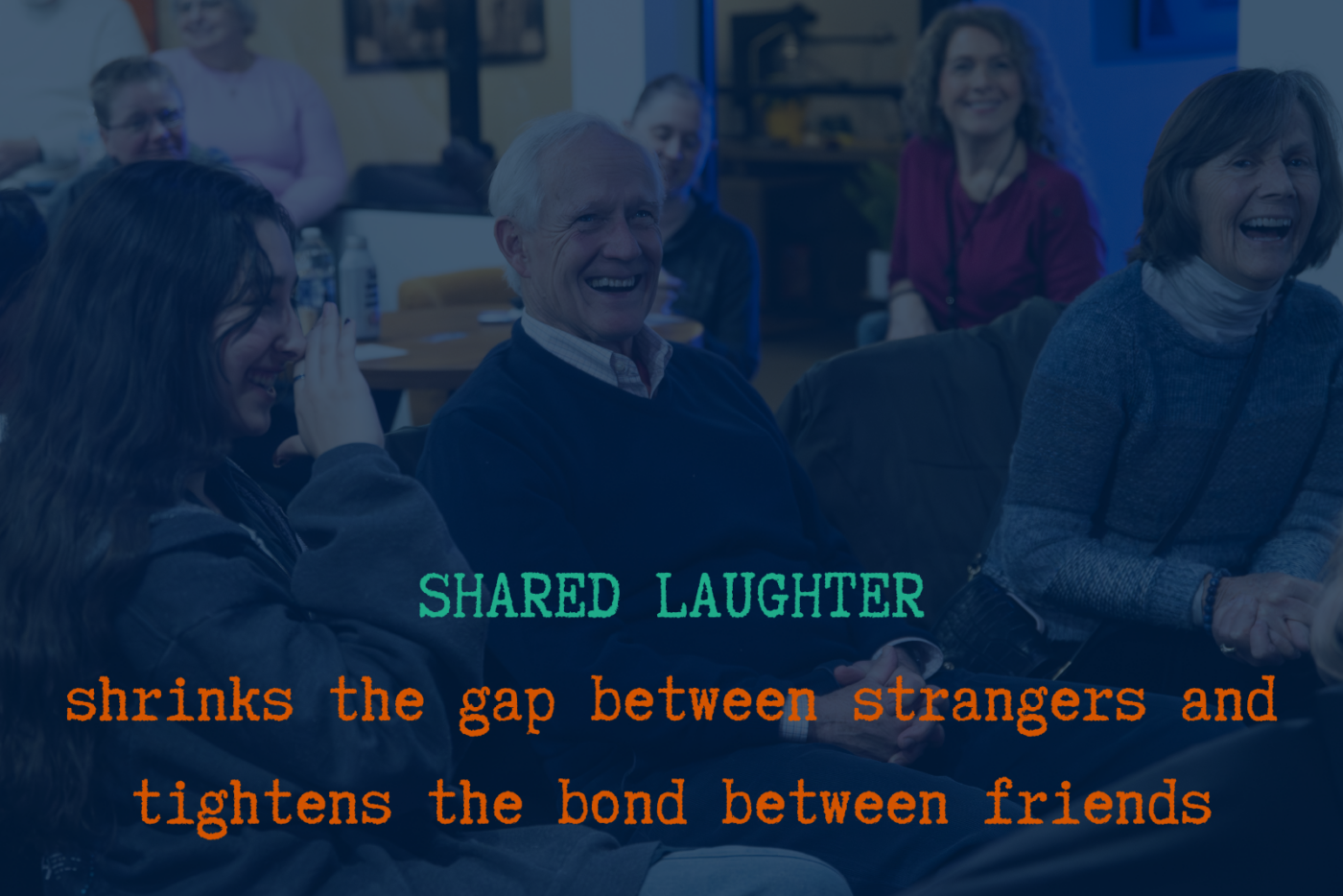
Shared laughter shrinks the gap between strangers and tightens the bond between friends.
We call that SHUAC: Seen, Heard, Understood, Appreciated, Connected.
For a long time, I thought of those as five separate things. Five boxes to check.
I'm starting to think they're really one thing wearing five names.
The high five is SHUAC in physical form.
You saw me.
You heard me.
You understood, without understanding anything at all, that something mattered to me.
You appreciated the moment enough to join it.
And for two seconds, we were connected.
That's why I don't think live experiences are simply about what happens on the stage.
Something happens between the people in the room.
And sometimes the best part is that nobody planned it.
A recording can make you laugh alone in your kitchen.
Fine. Good, even.
But it can't make you turn your head.
And it definitely can't make you the reason somebody else turned theirs.
I think about the wings-and-Wi-Fi guy sometimes.
I'll never see him again. I couldn't pick him out of a lineup two hours later, and he definitely couldn't tell you who scored.
I think about the golf guy, too, whose enthusiasm I still don't know the significance of.
And for two seconds, on two different Sundays, over two things neither of us fully understood about the other, we were exactly, completely, uselessly the same.
That's not nothing.
That might be the only thing.